Emboss from Component
Introduction
This topic will explain Emboss from Component, describe where to access it, explain the options found in it, and provide links to related topics.
Emboss from Component
Emboss from Component allows you to create Component/STL files from either a single emboss feature or an entire emboss model (To learn more, use the links at the end of this help topic.) The component is saved as an .stl file. These components can then be used to create one or more features using the Emboss from Component feature. Because the component is saved with the .stl extension, just about any .stl file can be used to create a component.
Navigation
To create an Emboss from Component feature:
-
Right-click
 Emboss Model, and click Emboss from Component.
-
In the Open dialog, locate and select a component/.stl file, and click Open.
The Emboss from Component dialog displays.
Parameters
Quick Access
-
 Apply - regenerates the canvas to display the current parameters of the feature.
 -
 OK - regenerates the canvas to display the current parameters of the feature and exits the dialog.
 -
 Cancel - discards the updates to the parameters and exits the dialog.
 -
 Show or Hide all images in the graphics area - This option will show all hidden images in the graphics area. This same option will hide all images in the graphics area, besides the one being worked on for those features which utilize a loaded image.
 -
 Show or Hide the embossed BobART model in the graphics area - This option will show the hidden canvas in the graphics area. This same option will hide the visible canvas in the graphics area.
Attributes
- Name- indicates the feature name that displays in the BobART tree.
By default, it is automatically named by the feature type and
number. Note that you cannot use the hyphen (-) character with
spaces around it, as this is reserved for the automatic naming
and will be removed. You can however use it without spaces, for
example, Emboss-Body).
- Color - click the drop down to select a Theme Color or Standard Color, or click More Colors to open the Select Color dialog. Select the desired color for the feature, and click OK to set the color, or Cancel to exit the dialog.
Application Type
These options are explained in more detail in the Application
Types help topic.
| Add | Subtract | Merge High | Merge Low |
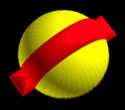
|
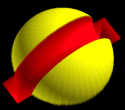
|
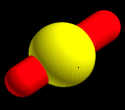
|
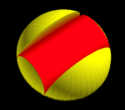
|
- Add - Builds up on top of the existing features.
- Subtract - Pushes down into the existing features.
- Merge High - Builds up independent of the existing features and intersects as needed.
- Merge Low - Builds up in place of existing features.
Tip: In the
Emboss from Component dialog, you can change the color to make
it easier to view the component while you are modifying parameters. This
can be helpful when multiple features share the same color.
Component
-
Load Component File - Clicking this button will launch the Open dialog allowing you to select the .stl to load. Once selected, the name of the file will appear below.
Origin
|
|
|
| The list box will list the entity currently selected to act as the origin. | |
The Origin group sets
the component location using the XYZ coordinate
-
X - determines the location along the X-axis of the
-
Y - determines the location along the Y-axis of the
-
Z - determines the location along the Z-axis of the
Size
The Size section displays the current size of the component. You use the following parameters to adjust the size of the component.
- Keep
Same Ratio
 Select the check box to keep the same ratio between the X Size, Y Size,
and Z Depth. When you edit one of these parameters, the others are automatically
calculated to retain the original size ratio.
Select the check box to keep the same ratio between the X Size, Y Size,
and Z Depth. When you edit one of these parameters, the others are automatically
calculated to retain the original size ratio. Clear the check box to edit the X Size, Y Size, and Z Depth parameters
independently from each other. When you change one of these parameters,
the others are not changed.
Clear the check box to edit the X Size, Y Size, and Z Depth parameters
independently from each other. When you change one of these parameters,
the others are not changed. - X Size - is the total
size of the component along the X-axis.
- Y Size - is the total
size of the component along the Y-axis.
- Z Depth - is the total size of the component along the Z-axis.
Orientation
The Orientation section contains options to rotate and/or mirror the component as follows.
Rotation Angle Around Axis
The rotation parameters do not limit the angle of rotation in order to allow you all creative possibilities.
Tip: When rotating in X or Y, generally you should use values less than 90 degrees. For example, a 90 degree rotation may remove much of the detail of the component because embossed models cannot contain undercut areas. As another example, a rotation of greater than 90 degrees begins to appear as inverting the component. If you are not sure, experiment until you find the desired result.
- X -
is the amount of rotation around the X-axis.
- Y -
is the amount of rotation around the Y-axis.
- Z - is the amount of rotation around the Z-axis.
Mirror
The Mirror parameters are used to mirror the component across one or more of three planes as described next. You can use any combination of the three mirror planes.
Select the check box to turn on the option.
Clear the check box to turn off the option.
- X-Z Plane - mirrors the component (horizontally)
across the XZ plane (or the X-axis).
- Y-Z Plane - mirrors the component (vertically) across the YZ
plane (or the Y-axis).
- Invert Only - inverts the component across the XY plane. (Raised areas are lowered, and lowered areas are raised.)
Zoom Fit
The Zoom Fit group is used to fit the view of the component, canvas, or both in the preview window of the Create Emboss from Component dialog box.
- Canvas
- fits the view of the canvas to the preview window.
- Component
- fits the view of the component to the preview window.
- Both
- fits the view of both the canvas and the component to the preview
window.
Zoom
The Zoom group is used to zoom in or out based on the current Zoom Fit selection.
- In
- moves the view closer.
- Out
- moves the view further away.
Tip: In the
Emboss from Component dialog box preview, the component origin is always
the lower-left corner. Even when the component is mirrored or rotated,
the origin is updated to be the lower-left corner as shown in the following
images.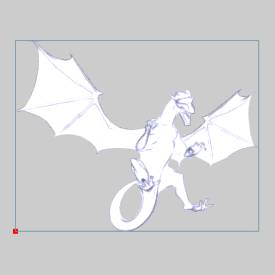
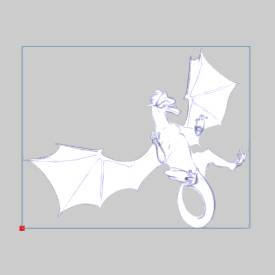
-
OK - accepts any changes and regenerates the canvas. (The first time you click OK, the feature is created and added to the BobART tree.)
-
Cancel - cancels the creation of the feature (the first time that the dialog box is displayed). When editing the feature, this cancels any changes and closes the dialog box.
After defining the parameters, you use the Emboss Features in the BobART Tree to edit the feature as needed.
The Emboss Feature in the BobART Tree
When you finish defining the feature parameters and click OK, the feature is added to the BobART tree. You right-click each feature item in the tree to access a shortcut menu.
The Feature Shortcut Menus
 Emboss from Component
Right-click this item to access the following commands.
- Edit - opens the Feature dialog for you to modify the feature parameters.
- Delete - removes the feature from the tree. Regenerate to view the change in the model.
- Suppress/Unsuppress - is used to remove the feature from the model or to restore a suppressed feature. To update the model, Regenerate.
- Save As Component/STL - is used to save the feature as a component or .stl file. This saves the individual feature and not the entire model. The STL Save Option dialog box is displayed for you to set the tolerance. Next, the Save As dialog is displayed for you to select a location, name the file, and save it. The component can be used to create an Emboss from Component feature.
 Component
Right-click this item to access the following command.
-
Re/Load Model File - displays the Open dialog box for you to locate and select a component/.stl file. You can use this option to replace the current component for the feature. The new component is applied to the model when you regenerate.
Generating the Model
After all necessary selections are made, you must regenerate to create the model.
To Regenerate the Model, do one of the following:
- From the BobArt Tree, right-click
 Emboss Model, and click Regenerate.
 - From the feature dialog, click OK.
Note: Every time a change is made to an Emboss feature, you must Regenerate to update the model.
